Mapping Manipulation of Research. Because you cannot fix what you cannot see.
The Forensic Scientometrics (FoSci) Report – giving publishers, institutions, funders, and policymakers a framework to strengthen research integrity and rebuild trust in science.
Research is vast, from discovering pathways of dementia to interrogating knowledge itself. It operates across an equally complex landscape. Researchers work in laboratories and on laptops, alone and in collaboration, connected through dense networks that shape how findings are created, communicated, and interpreted. Universities, publishers, governments, funders, and the media all influence this system. Each node and connection can support scientific progress, or distort it.
In our first FoSci report – launched at the 9th World Conference on Research Integrity (WCRI), in Vancouver, Canada – we present a primer on how research is manipulated across this landscape, degrading research integrity and trust. Structured across three main levels of research manipulation – micro, meso, and macro – the report offers a snapshot of current research integrity practice, its level of maturity, and what’s needed to address critical gaps.
Among the authors, there was genuine pride in finally having something to point to legitimising our work. For many initial readers, the scale of manipulation, particularly at the meso and macro levels, came as a genuine surprise.
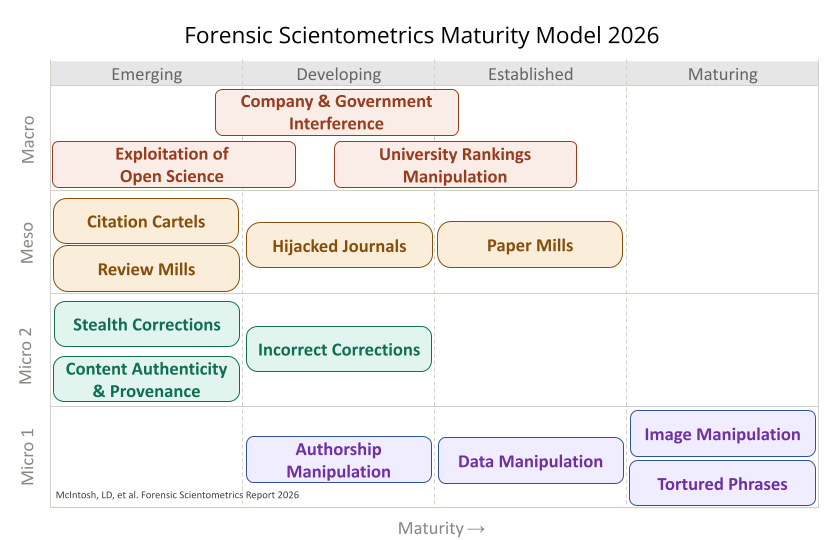
Much of the public conversation focuses on micro-level issues, such as data fabrication or image manipulation within individual papers. These are the visible incidents, the crime scenes of science. They are important, but they are only the entry point.
Beyond this, the report examines how decisions made by publishers and institutions shape the scientific record itself. Corrections, retractions, expressions of concern, or the absence of them, influence what knowledge persists and what is quietly buried.
At the meso-level, patterns begin to emerge and actions are no longer isolated – from papermills to hijacked journals. They resemble coordinated activity, more akin to a criminal network than a single bad actor.
At the macro level, the stakes shift again. Here, manipulation operates through governments and organisations that shape research agendas and influence global narratives. These forces do not just affect individual papers or journals, they reshape the web of science itself. The analogy moves from crime scene to network to something closer to intelligence operations, where influence, strategy, and long-term positioning define the terrain.
What becomes clear across these levels is that science is not only vulnerable to manipulation, it is being actively shaped in ways that are not always visible to those who rely on it. Despite this, only a small group of researchers and practitioners systematically investigate these dynamics.
In this report, 17 authors – among them scholarly sleuths and investigators of science, from academia and industry – come together to present a primer on the field of forensic scientometrics. Forensic scientometrics has been quietly developing for a couple of years, but without a shared framework to unite it. This report aims to provide one.
This emerging discipline provides the tools and frameworks needed to detect patterns of manipulation, understand their impact, and begin to respond in a structured way. It builds on efforts such as the Paris Declaration, while pushing further into the operational realities of how science functions today.
If we continue to evaluate scientific trust based only on what is visible at the surface, we will miss the structures that shape and support it. For policymakers, publishers, institutions, and funders, this raises uncomfortable but necessary questions. What signals of trust are you relying on? Where are the blind spots? And how resilient are your systems to coordinated manipulation?
Fixing these problems rests on the collective shoulders of many. Publishers, institutions, and funders can all intervene at different points – through how research is communicated, how researchers are managed, where money flows, and how claims are checked. Progress depends on these groups acting together.
Think of it less as policing and more as basic housekeeping. Libraries track their books for good reason; the same logic applies here. Without baseline visibility into the manipulation of science, correction and accountability become impossible.
And accountability has to mean something. When misconduct is found, like participation in paper mills, it should follow people into funding panels, hiring committees, and editorial decisions. Continuing to reward compromised actors and action entrenches the problem. The reverse is equally true: researchers who do rigorous, ethical work deserve to be recognised for it.
This inaugural FoSci report is an invitation to look more closely at the pressures bearing down on trusted science. The maturity model is intended to be a working tool; something you can use to assess risk, identify weaknesses, and strengthen trust before crises emerge.
The honest question is: where are you on this map, and what would it take to move forward? The future of trusted science will not be determined by mission statements and checklists, but by the willingness of anyone engaged with and supporting trustworthy science to confront vulnerabilities, implement safeguards, and reward integrity even when it is inconvenient.
Read The FoSci Report 2026: Understanding, Detecting, and Documenting Manipulation in the Research Ecosystem: https://doi.org/10.6084/m9.figshare.32178456