Research Integrity IS Research Security
There are two offices at most universities dealing with foreign (and domestic) research interference. One handles research integrity — the rules, values, and practices that keep science honest and reproducible. The other manages research security — protecting sensitive knowledge from external threats. Between them, a gap that bad actors are already exploiting.

The French Office for Research Integrity (Ofis) named this problem directly in a prospective note published in February 2026: the operational handling of foreign interference “largely falls under the responsibility of security and defence stakeholders… not intended to address issues of research integrity”. But research interference does not just target one place — or even the 10 ‘critical technologies’ stated by the European Commission as high risk to thwart economic development. While scoping risk is important to address interference, not addressing the integrity of research still leaves countries vulnerable to malicious acts.
It is also worth noting, and Ofis is careful to acknowledge this, that interference does not only arrive from foreign actors. When a political system interferes with its own research community, shaping what can be funded, published, or said, the mechanism is identical. The label “foreign” attracts policy attention while the domestic version often does not. That asymmetry deserves more scrutiny than it currently receives (but not in this post).
The Open Science Elephant in the Room
Science runs on trust and openness. International collaboration, shared data, and open publication are the conditions under which knowledge advances. The EU principle captures the tension well: research should be “as open as possible, as closed as necessary.” Yet that culture of openness is also the surface of attack.
If you suspected an infection, you wouldn’t amputate the limb. You would monitor it, treat it, and stay vigilant. Shutting down international collaboration wholesale to guard against interference would be the research equivalent of amputation. And smarter vigilance requires understanding precisely what we are defending against.
Three Vectors, One Problem
Foreign interference in research operates through three primary mechanisms. What makes them particularly dangerous is that each one simultaneously attacks research integrity and research security. They are not separate problems that happen to overlap; they are the same problem, approached from two different angles.
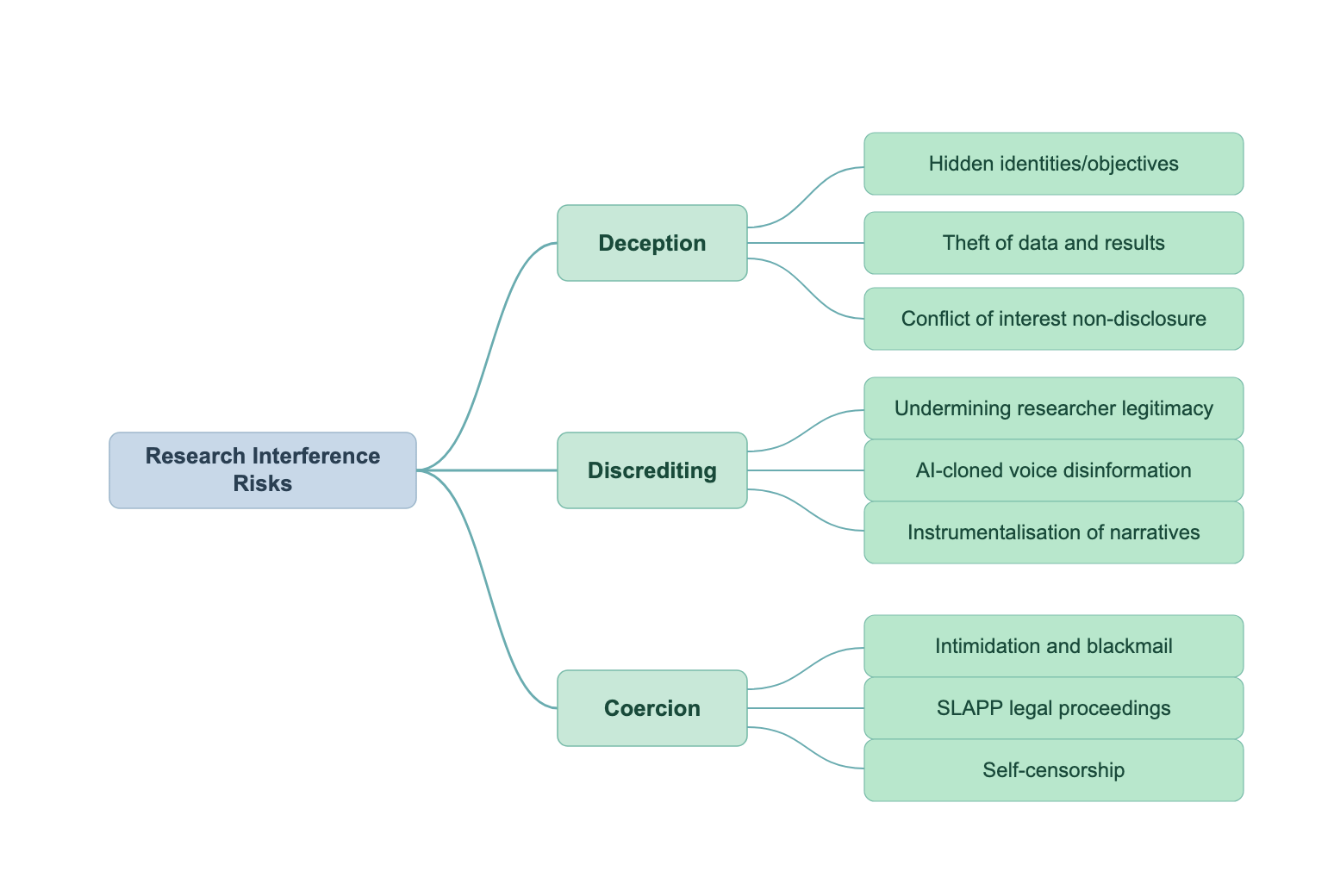
Deception involves concealing true identities, affiliations, or objectives in order to gain access to research communities and their outputs. Ofis cites a case brought by the US Department of Justice: a professor sentenced to prison for lying on funding applications, concealing his participation in a Chinese talent recruitment program while directing over $3 million in US grants toward building scientific expertise for a foreign state.
He declared no conflicts of interest to his employer nor to the NIH. He also has at least one paper retracted for apparent image manipulation in a publication (warning: unpleasant mouse images in link.) That is simultaneously a research integrity failure and a research security failure.
Discrediting involves targeted campaigns to undermine the credibility of researchers, institutions, or bodies of knowledge. Ofis describes a French laboratory that was subjected to a disinformation campaign timed to disqualify it from a major funding program. More strikingly, AI-generated deepfake videos were used to make academics appear to endorse political positions they never held.
When a researcher’s credibility is systematically destroyed, their science is dismissed along with them. When it is orchestrated by a hostile actor to erode institutional influence, it is an organised attack. Those are simultaneously a research integrity failure and a research security failure.
Coercion compels researchers to act against their scientific judgment — through intimidation, legal harassment, financial pressure, or the quieter force of sustained influence. The Cairn portal, which publishes French humanities and social sciences journals, received a request from a Chinese university to remove an entire journal issue devoted to China on the grounds that it was “sensitive”. (Cairn refused.)
In another example of coercion, researcher Maxime Audinet spent years studying Russian information operations and was subsequently sued for defamation. A Strategic Lawsuit Against Public Participation (SLAPP) action designed not to win in court, but to silence through cost and attrition.
As stated in the Ofis note, coercion leads to self-censorship, to research topics going unstudied, to entire fields becoming epistemically thin because the cost of working in them became too high. That is an integrity failure. It is also a security failure, because a democracy that cannot study its own vulnerabilities cannot defend them.
These three vectors converge: Deception creates false knowledge. Discrediting attacks those who challenge it. Coercion silences what remains.
Institutions are the Linchpin
Researchers cannot reasonably be expected to master cellular biology, lab financial management, and geopolitical threat assessment simultaneously. That is not a failure of individual researchers; they have enough on their plates (or petri dishes). It is a structural problem and falls to institutions to pick up some of the responsibility.
Research Integrity Officers (RIOs) are, as stated in the Ofis note, “not necessarily equipped or trained to detect or manage this type of risk”. The traditional misconduct toolkit (e.g., disciplinary procedures, individual awareness campaigns, academic sanctions) was designed for a different threat model. It assumes that the person who committed the breach did so intentionally, with full awareness. Interference-driven misconduct often involves researchers who were deceived, coerced, or influenced without ever intending to transgress scientific norms. You cannot sanction someone into retroactive awareness of manipulation they did not know was happening.
Compliance frameworks, however well-designed, address the symptom. What institutions actually need is one where research integrity and research security are understood as aspects of the same obligation, where RIOs and Research Security Officers (RSOs) operate as collaborators rather than parallel bureaucracies, and where the forensic capacity to detect patterns exists before those patterns become crises.
Towards Coordination and Beyond
Ofis identifies several directions for building a coordinated approach: raising awareness across both communities, adapting training for researchers in all disciplines, creating conditions for RIOs and RSOs to share information, and developing better knowledge of the scale and nature of interference. They are also predominantly educational solutions — necessary ones, but not sufficient.
What is still needed is an operational and investigative layer: the capacity to detect manipulation at scale, across publications, metadata, citation networks, and researcher behavior, before it becomes entrenched in the literature and policy it influences.
That is precisely the territory FoSci occupies. Forensic Scientometrics is a data-driven, investigative approach to understanding and decontaminating the research ecosystem. The Paris Declaration, which underpins FoSci’s mission, frames this as a collective effort to decontaminate a polluted scholarly ecosystem: not through emergency repairs, but through systematic forensic investigation. Through tools and techniques FoSci moves beyond awareness into detection.
Ofis calls for the “development of knowledge on foreign interference in research in order to assess the scale of the phenomenon”. FoSci exists to build exactly that knowledge and to make it actionable.
Research Integrity is Research Security
Research integrity and research security are not separate issues that occasionally intersect. They are different entry points into the same conflict — a conflict over who controls the production, validation, and circulation of trusted knowledge.
For research administrators: your RIO and RSO need to be working together. If they have never been in the same room, that structural gap is itself a vulnerability.
For policy-makers: the Ofis prospective note is worth your time. It calls for coordinated approaches, shared training, and new mechanisms for disciplines currently outside the dual-use framework including the humanities and social sciences, which are no less exposed and considerably less protected (emphasis and words mine). Fund the investigative infrastructure, not only the compliance checkbox.
For the broader research community: A shared culture of vigilance is needed. This is the scientific method doing what it has always done: interrogating claims, tracing provenance, and refusing to accept authority without evidence.
The battle for knowledge is not a future threat, it is the present condition. The question is not whether science will be contested, as it already is. The question is whether we build the capacity to contest back — addressing research integrity and security on a coordinated front.