What News and the Web Are Telling Research About Trust
I’m fortunate to work with colleagues who think deeply about knowledge production. Years ago, Leslie McIntosh said something that has stayed with me: “I’m afraid what happened to news will happen to research.”
Misinformation and declining public trust in science rightly get a lot of attention in conversations about research integrity, but she was pointing at something more structural: the systems we built to establish authority and trust are breaking down, and research might be next.
The more I sit with it, the more I keep thinking about parallels with Google.

What we should learn from news and the web
- The news ecosystem ran this experiment first
- Trust eroded for a mix of overlapping reasons: link signals got gamed at scale, social media disaggregated distribution from credibility, the business model collapsed, and AI-generated content has made the signal-to-noise problem dramatically worse. The result is a media environment most people no longer feel confident navigating.
The web has been running its own version of the same experiment in real time. A few dynamics in that experiment are worth research absorbing.
- This is a cat-and-mouse game
- Google has shipped major algorithm updates roughly every year for 15 years, each one a response to a new gaming technique. Panda targeted content farms. Penguin targeted link spam. The Helpful Content updates targeted low-value search-optimized content, increasingly including AI-generated text. Every fix prompted a new evasion. It is the same dynamic that has played out between codemakers and codebreakers throughout history: each side advances in sophistication as the other does. Defenders need to be right consistently, while attackers only need to be right, or even just believed, once. No one wins; the dynamic is permanent.
- Trust signals separate from quality signals over time
- What ranks well in Google is often not what users actually find useful. The architecture optimized for ranking, and ranking and credibility gradually diverged. Research has its own version of this: papers that accumulate citations are not always the papers that hold up under scrutiny.
- Users route around broken systems
- “site:reddit.com” has become standard search practice for many queries. People found their own way to a trust signal that worked for them, and Google’s authority infrastructure became increasingly irrelevant to the questions they actually wanted answered. The research equivalent is starting to appear: scientists who follow experts on social media, newsletters, or preprint communities, bypassing journals for the questions that matter most to them.
- The cure can be worse than the disease
- Google’s response to AI-generated content has been to generate AI summaries that may bypass the publisher ecosystem entirely. Solving signal corruption that way risks damaging the system itself. The research version of this is worth watching: aggressive interventions on integrity could fragment the open exchange that made science work in the first place.
What’s already happening to research
Research authority has been under pressure for years, and the research integrity community has been documenting it carefully. Retraction Watch and COPE have been raising flags for over a decade. DORA challenged the over-reliance on impact factors. Registered reports and preregistration are reshaping incentives. There is a serious ecosystem of people doing this work.
The gaming patterns above are not theoretical. They are well-documented, growing, and increasingly industrial.
What’s changing now is the speed and scale. The same dynamics that broke news and degraded the open web are arriving in research, and they are accelerating.
Where we’re heading
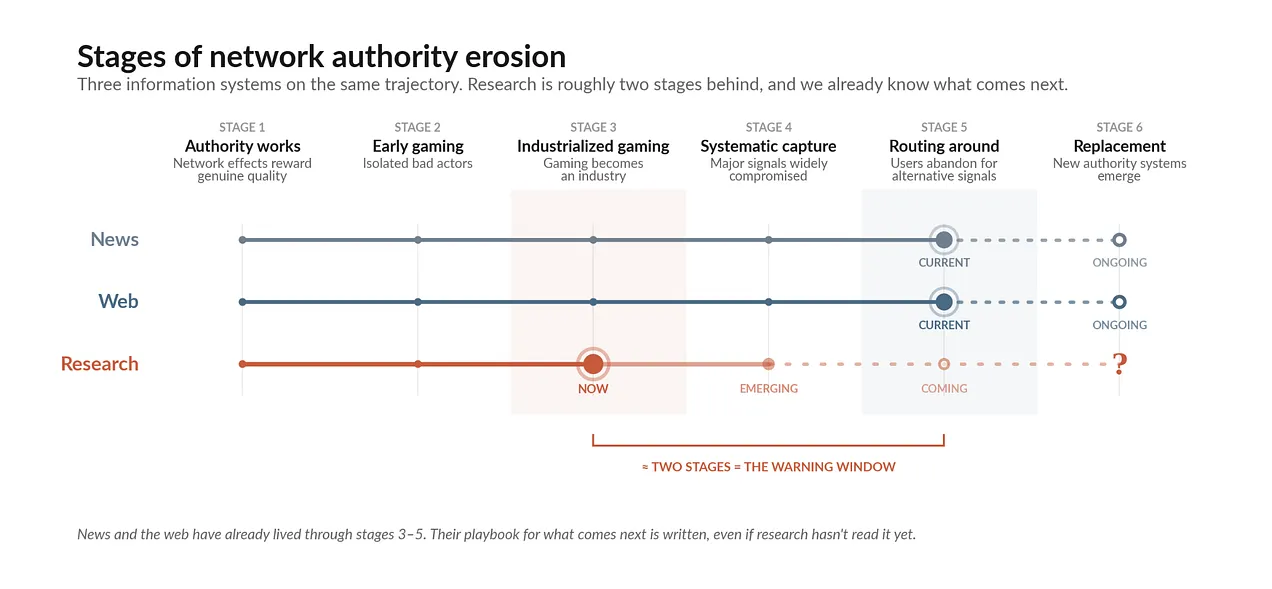
Right now research sits at stages three and four. Gaming has become industrial. The systematic compromise of major signals is starting to show. News and the web are two stages ahead, already in the routing-around phase, with users finding their own alternative trust signals and abandoning the original authority systems.
That gap between where research is and where news and the web already are is what makes the trajectory predictable. We can see what stages five and six look like in the other two systems: wholesale abandonment of the formal authority system, migration to alternative trust signals, and the slow emergence of new credentialing infrastructure outside the institutions that used to hold it.
The milestones to watch are not abstract. Researchers and funders quietly bypassing journals for AI-mediated discovery. Public trust in scientific institutions decoupling from trust in individual scientists. Funders moving away from traditional credentialing signals because they no longer reliably indicate quality. Each is already starting to happen at the edges, though none of them is yet mainstream.
The pattern underneath
Across all three systems, the same underlying shift is happening: the decentralization of authority. The centralized network systems that defined the twentieth-century information landscape, major journals, major news outlets, and eventually Google itself, are losing their gatekeeping power. Authority is migrating outward, to distributed and alternative infrastructure.
The pattern is bigger than any one of these fields. What looks like a crisis in research authority is part of a wider reconfiguration of how societies establish and maintain trust. The question for research is whether the field shapes what comes next, or whether it gets shaped from outside.
Can any of the web’s solutions work for research?
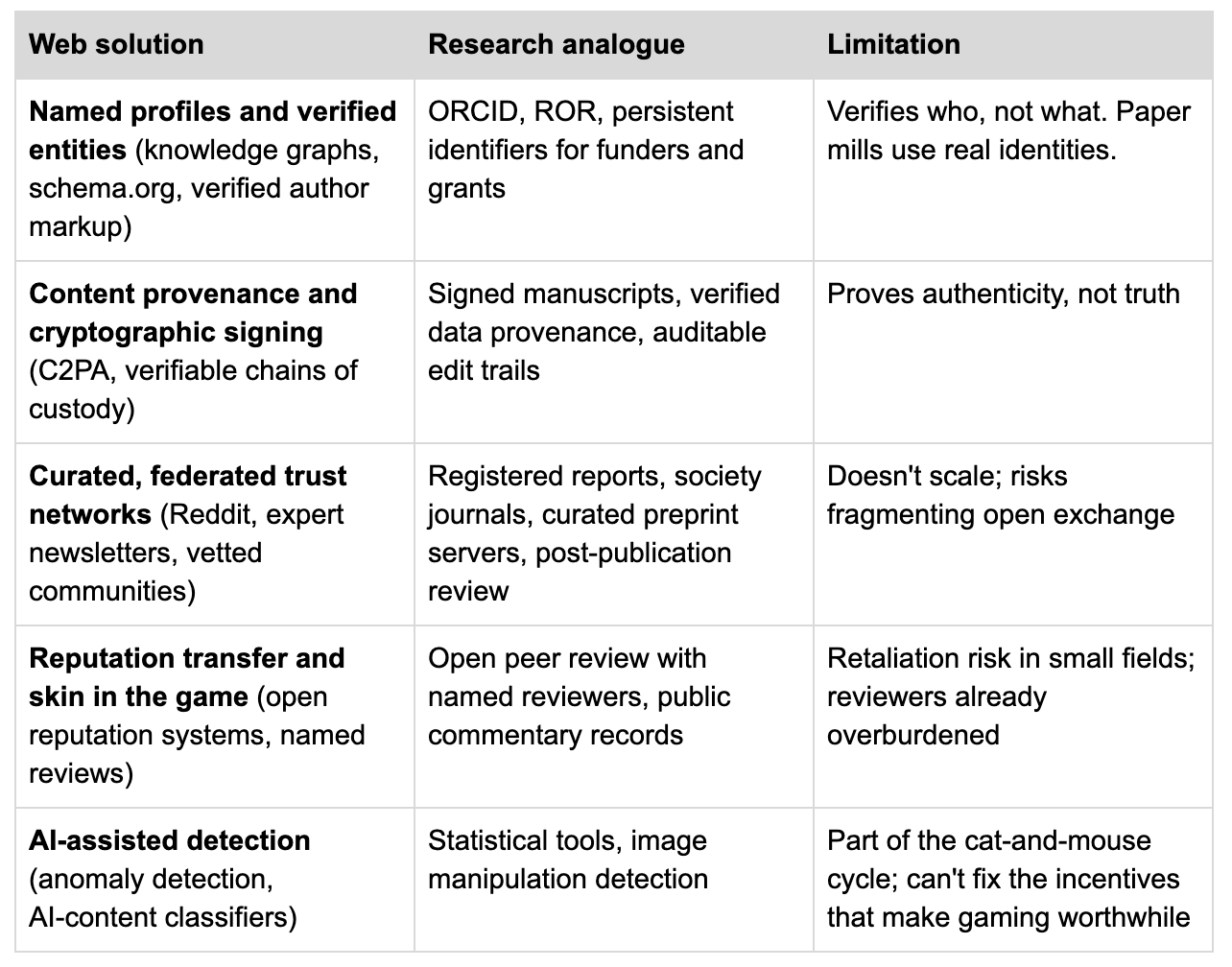
- Alternative credibility infrastructure
- The most speculative possibility, and possibly the most important. PubPeer has been doing a version of this for over a decade: post-publication commentary, often anonymous, that has surfaced significant integrity issues. It is a proof that an alternative trust layer can emerge and matter. But it emerged organically rather than by design, and the dynamics that come from that (anonymous commentary, no formal weight in evaluation, limited adoption outside specific communities) are real. Research’s “Reddit” already exists in PubPeer. The open question is whether the field builds on that deliberately, with explicit curation and reputation systems that carry weight, or lets the informal version remain the only version.
The web’s experience suggests something important about what works. The most resilient systems combine entity-level verification, content provenance, human-curated trust layers, and constant updating, and they accept that the cycle never ends. Research has most of these components already. It does not yet have the integration.
The signals funders and institutions use to evaluate research quality, citations, impact factors, journal prestige, are the same signals being gamed. That degradation is quiet and gradual. We don’t need to abandon the existing research publication infrastructure but we should pay close attention to what’s happening at its edges.
The earliest signs of users routing around the system are already visible there. Funders building their own intelligence instead of relying on citations and impact factors. Non-researchers trying to evaluate scientific questions through social media networks where expertise is hard to verify. Post-publication review communities gaining real influence. That’s where the next authority system is being shaped, deliberately or not.
From where I sit, these fields are still mostly working in their own silos. Research integrity people, science of science researchers, web infrastructure thinkers, and news strategists are all working on versions of the same problem. The work now is to learn from the fields that saw it first.
Acknowledgements
This piece builds on Leslie McIntosh’s (VP of Research Integrity and Security at Digital Science) framing, “what happened to news will happen to research,” which she shared with me years ago and which I haven’t been able to stop thinking about. Thank you to Leslie for that, and for sharpening this piece in editing, including the cat-and-mouse framing.
I used AI (Claude) as a thinking and editing partner while writing this piece. The ideas and cross-field syntheses are mine; the AI helped with structure, drafting, image generation, and editing toward my voice. I’m flagging this because the piece is about authority and trust, and being transparent about my own process feels consistent with the argument.