Spoofing an Institution: Pepper’s Ghost
Our societies are made predictable and manageable through institutions. It’s through institutions that a public interest comes to be refracted.
While reading Geoff Mulgan’s When Science Meets Power, that phrase caught my eye as he discussed the role of institutions in democracy.

Refraction, a concept that describes how light bends as it passes through different media, is a fascinating word choice. It conjures images of light scattering rainbows across the room from a prism hanging in the window or casting indirect illumination onto a balcony. Refracted light, while not direct, is still authentic. It travels at different speeds through various substances yet retains its essential properties, capable of both warming and burning skin.
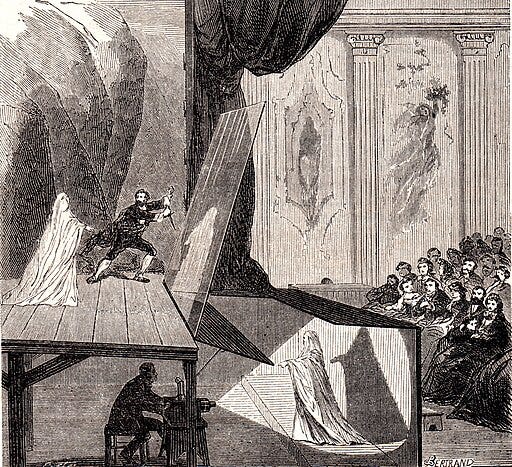
But when does refraction become illusion? Pepper’s Ghost provides a view to understanding; it is a Victorian parlor trick that creates the appearance of spectral forms. It’s an illusion where you see an image, but the physical object isn’t present.
Imagine a camera aimed at a dark, matte surface. Perpendicular to this, place a cutout: an apple, perhaps, or a human figure - or a cat that can sit still for a photoshoot. Now, position a plexiglass sheet at a 45-degree angle from the camera, connecting the corners. Take the picture. The resulting photograph captures not the cutout to the right but its reflection in front of the camera, which the human eye interprets as a ghostly apparition.
How does this relate to Mulgan’s assertion about institutions refracting public interest?
This sleight of hand forces us to question: How often do we mistake reflection for refraction in institutions? When does the bending of light become a manipulation of truth? In a world where appearances can be so easily engineered, we must learn to distinguish between authentic refractions of public interest and the seductive reflections of Pepper’s Ghosts.
When Institutions Become Illusions
Some institutions genuinely refract the public good, bending it through the structures of governance, ethics, and accountability. Others, however, operate more like Pepper’s Ghosts, shimmering with legitimacy, yet hollow behind the glass.
And that brings us to research.
In recent years, we’ve grown familiar with fake authors, paper mills, and manipulated peer review. But alongside fake people, there are fake institutions, entities that exist only to lend an aura of credibility to dubious research. These range from websites with no physical presence to shell companies claiming research breakthroughs that could never have occurred in their nonexistent labs.
From Fake Authors to Fake Institutions
If authorship fraud distorts the who of science, institutional spoofing distorts the where. Both threaten the same foundation: trust in the provenance of research.
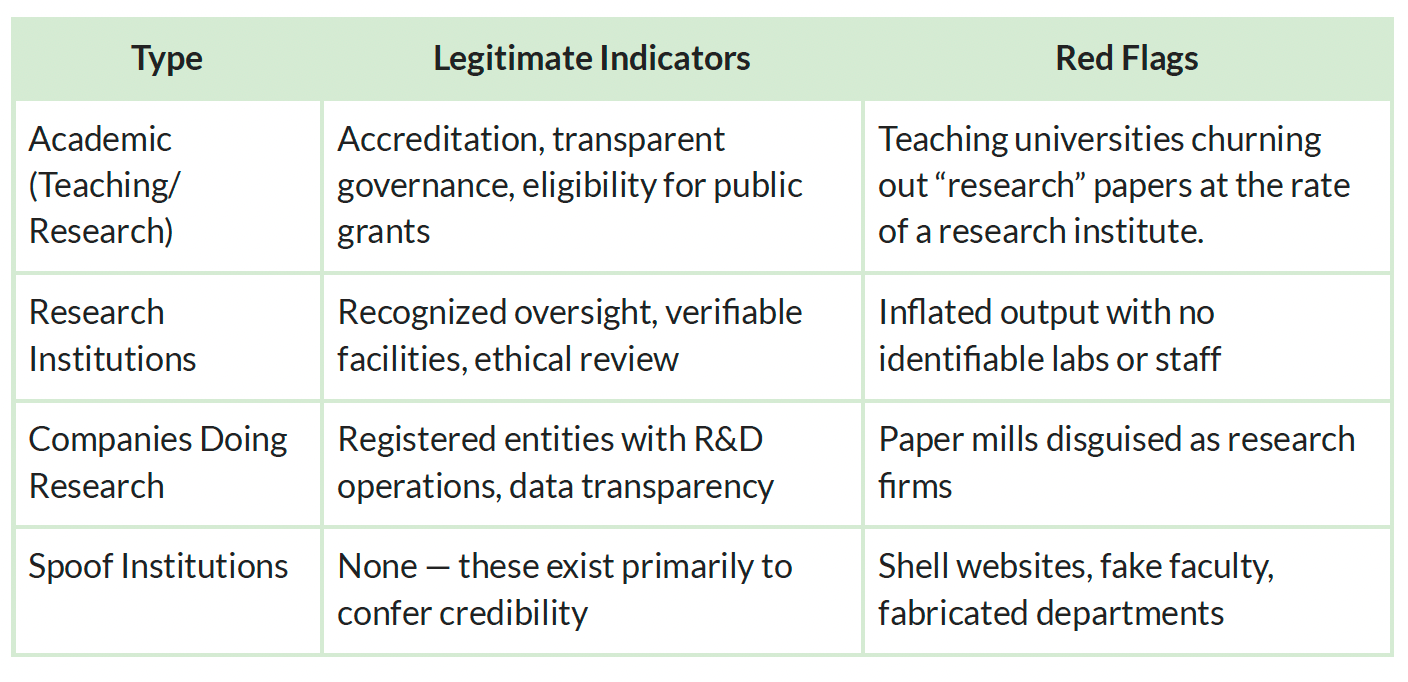
So what makes an institution real, one we can trust to produce credible science? Not all “institutions” are alike. Some are accredited universities or government-funded labs; others are shell companies, think-tank fronts, or placeholders registered to empty offices. Many sit uneasily in between.
Imagine a spectrum (because I love to classify things):
The Spoof Institution Problem
Spoof institutions operate like Pepper’s Ghosts in the research ecosystem, reflecting legitimacy without substance. They lend prestige to authors, grant the illusion of institutional oversight, and often hide deeper manipulations.
In our investigations of the Pharmakon network, we’ve seen several of these mirages:
An “educational institution” in suburban Sydney with no campus, just a single-family home.
A “company” registered above a massage parlor, claiming to conduct advanced neuroscience.
A “plant research organization” registered in Cork, Ireland, without facilities, labs, or even an office.
Each exists primarily as a reflection — a projection of credibility intended to deceive editors, funders, or the public.
Then, some institutions go further, like those created to push agendas. The Advancement of Sound Science Center, funded by Philip Morris, was one such example. Its name evoked neutrality and reason, but its true mission was to undermine legitimate research on the harms of smoking. These organizations do not simply reflect the light of science; they twist it into misdirection.
Distinguishing Refraction from Reflection
When, then, does the bending of light become the manipulation of truth?
In science, as in optics, context matters. Genuine refraction requires a medium: transparent governance, ethical oversight, and traceable funding. Reflection, by contrast, comes from a surface designed to impress, not to transmit.
In an age where institutions can be fabricated with a website, a rented address, and a logo generator, we must learn to discern the authentic refractions of public interest from the Pepper’s Ghosts and take action. Actions like making organizations identifiable and verifiable.
Science is built on trust, but will rapidly decay without verification —leaving the specters of knowledge haunting the halls where rigorous debate once lived.
Happy Hallowe’en