Author Check: The IMDb of the Research World
Hardly a movie or TV series goes by without that nagging question: “Where have I seen that face before? Weren’t they in that other movie?” Back in the day, you might have asked a well-informed friend. Today, the Internet is our ever-present companion, and we have vast online resources to satisfy our curiosity—foremost among them, IMDb, the world’s most comprehensive movie database.
Providing solutions to the craving to know who starred alongside another person in a movie started in 1994 when three students were watching television during a heavy snowstorm when they noticed something remarkable: Kevin Bacon, whose next movie had been announced on TV, appeared in countless films with a wide variety of co-stars. They speculated that Bacon might be the “center of the entertainment universe,” and thus began the meme-like phenomenon of the “Six Degrees of Kevin Bacon.” A dedicated website, the “Oracle of Kevin Bacon,” soon sprang up, allowing anyone to see how quickly any actor could be linked to Bacon via co-stars.
Yet IMDb has taken this a step further, transforming a casual movie-watching experience into an addictive rabbit hole of actor searches and cross-references. You might click to see who else starred in Footloose (“Wait, who played the minister’s wife again?”), then discover that actor’s entire filmography, and before you know it—an hour has vanished in Hollywood’s cinematic web. (The joys of engaging with metadata!)
That got me thinking: What if there were a similar, user-friendly tool for exploring the web of scientific researchers and their co-authorships? There are many databases—Google Scholar or ORCID —but none really provides a quick, holistic view of collaboration patterns. There is now an app that just does that (and a bit more) called Author Check app, but first a couple of excursions.
Excursion 1: From Actor to Researcher Small-World Links: Of Kevin Bacon and Paul Erdős
Surprisingly, a similar concept exists in academia to the “Six Degrees of Kevin Bacon”. Mathematicians and scientists speak of “Erdős numbers,” which measure how closely researchers have co-authored papers with the prolific mathematician Paul Erdős. Some authors have Erdős number 1 (direct co-authors), others 2 or 3, and so forth. Much like the Bacon number, it’s a testament to how tightly connected seemingly distant people can be in a professional network. This phenomenon is part of the broader “small-world” effect: once you start mapping out these connections, you’ll be amazed at how quickly any two individuals can be linked—whether through film credits or joint scientific publications.
Excursion 2: From Researcher to Acting credentials in IMDb: Stephen Hawking
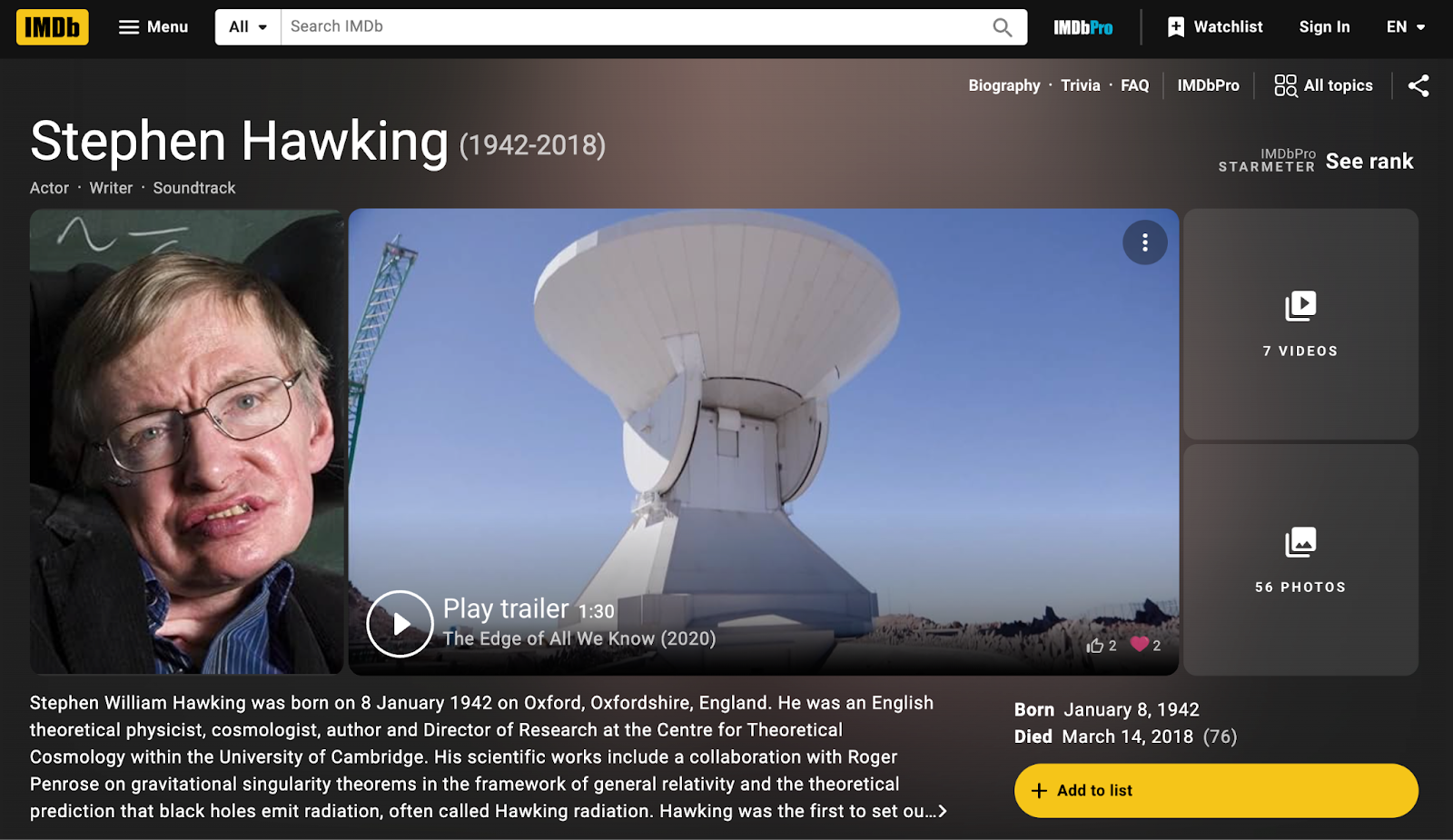
Stephen Hawking made numerous cameo and voice appearances across film and television, often portraying himself as seen on IMDb. Highlights include his guest spot as “Professor Stephen Hawking” in a 1993 episode of Star Trek: The Next Generation and multiple appearances on The Big Bang Theory (2012–2017). Hawking also lent his voice to: animated comedies such as Futurama; the feature-length The Beast with a Billion Backs (2008); and, the television series The Simpsons (four episodes, 1999–2010). Other notable credits range from a cameo in Stargate: Atlantis (2008) to playful shorts like Anyone Can Quantum (2016), showcasing his role as a brilliant scientist and a pop-culture icon.
The Parallels: Movies vs. Research
At first glance, movies and research outputs might seem worlds apart. But if you think about “people as connecting nodes,” the parallels are clear:
- Actors star in a film together, much like researchers co-author a paper.
- Hopping from one movie or actor to another is very similar to jumping from one paper to another and from one co-author to the next.
- IMDb helps you track an actor’s entire career, find collaborators, and gauge a film’s success (or flop). For researchers, a comparable platform could identify co-authors, notable publications, and academic impact.
Naturally, you can use Google (or any other web-based search) to find a researcher’s name or look them up on Google Scholar. But if you want the complete picture—the interplay of who worked with whom, how often, in what fields, and which papers might have been retracted or flagged—you need something more specialized.
Introducing the Dimensions Author Check App
Think of Author Check (powered by Dimensions) as a one-stop shop for exploring collaboration networks in research. Beyond compiling publication records and listing co-authors, it offers a comprehensive snapshot of a researcher’s history, affiliations, and thematic expertise–with links to the underpinning metadata. At its core is a commitment to research integrity—the app actively flags if an author is linked to retracted papers or questionable data, directly or indirectly via his/her coauthor network. It draws on reputable sources like Retraction Watch and Crossref retractions. This functionality helps uncover patterns or trends that might otherwise be buried: for example, repeated co-authors on multiple retracted studies, or entire networks of publications associated with ethical concerns.
Leveraging Dimensions’ extensive database, Author Check can also highlight relevant metrics—such as citation counts, publication dates, affiliations, and disciplines—giving you the broader context behind a researcher’s career. All of this is displayed in a user-friendly interface that makes it easy to spot “red flags,” like sudden spikes in highly cited but later-retracted work, or collaborative clusters with repeated credibility issues. These insights are invaluable not only for institutional review boards and journal editors but also for fellow researchers who want a due diligence step before embarking on a new collaboration.
Just as IMDb sometimes reveals an actor’s behind-the-scenes drama, Author Check shines a light on a researcher’s professional “plot twists.” It doesn’t merely show who co-authored with whom—it can also reveal controversies, retractions, or ethical questions, helping maintain academic credibility and scientific rigor. By placing a premium on transparency, Author Check ultimately empowers you to assess the validity of a potential collaborator’s work, navigate tricky ethical waters, and safeguard the integrity of the research community as a whole.
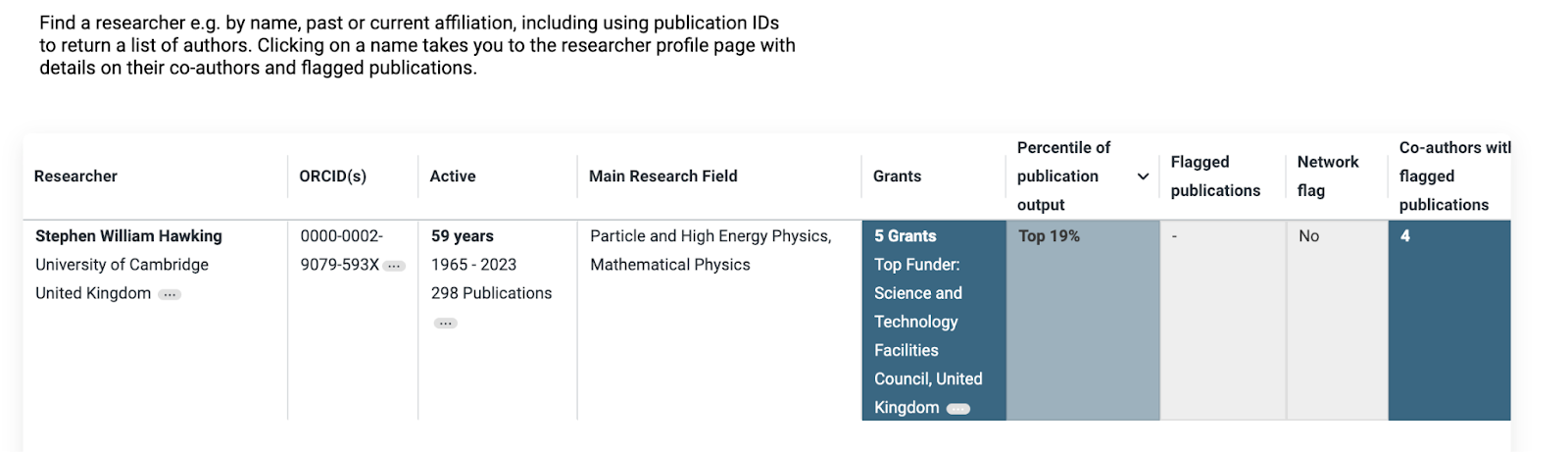
Stephen Hawking’s overview in Author check
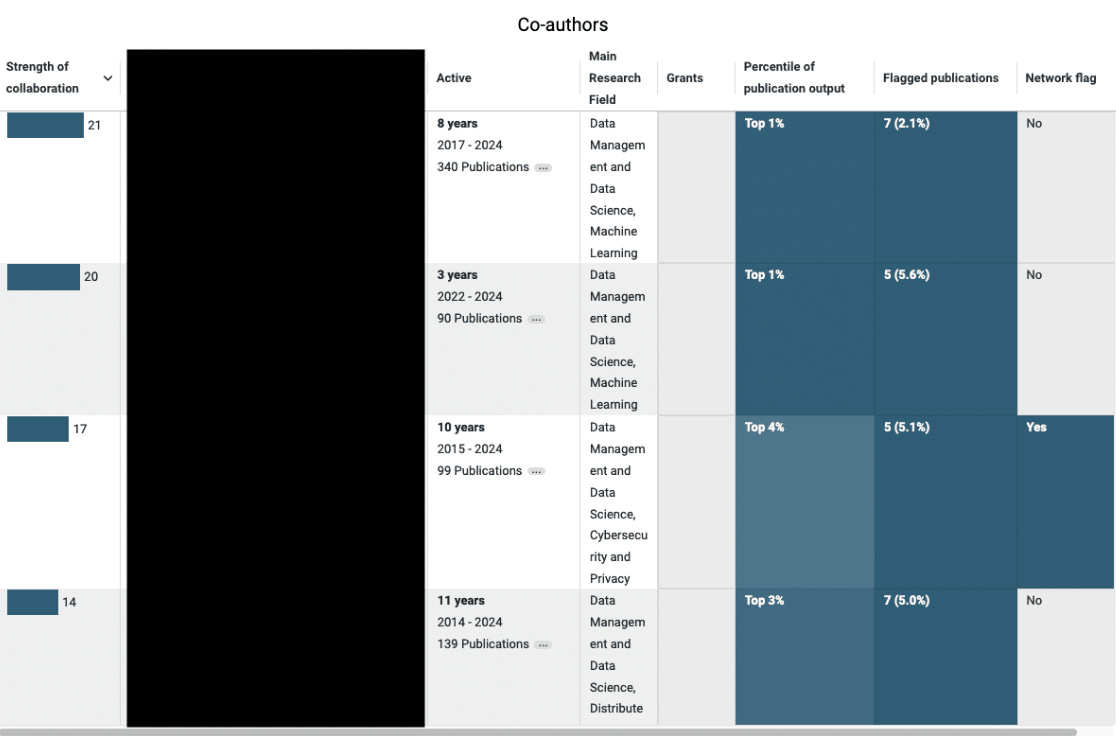
Coauthors and flagged publications -anonymized (NOT Stephen Hawking)
Why It Matters
The potential goes far beyond academic gossip. These collaboration views—where flagged content and networks are visible at a glance—foster transparency, accountability, and collaboration. Identifying shared interests or discovering red flags early can help researchers connect productively or steer clear of pitfalls. Plus, there’s a fun, detective-like aspect—much like tracing a Bacon number—when you find out your academic hero might be only a few co-authors away. You can even hop from one author to the next, just as you would on IMDb.
Closing Thoughts
Much like IMDb, Author Check offers quick, instant views of researchers and their networks, with an added emphasis on research integrity. Anyone can delve into a researcher’s collaborations, discover hidden connections, and see the bigger picture of academic endeavors. The next time you catch yourself chasing an actor’s filmography on IMDb, remember there’s an equivalent chase unfolding in the academic world—one that helps scholars uphold rigor, transparency, and trust in scientific progress.